How research is integrating into Business on the Frontlines
At the University of Notre Dame, business school Dean Martijn Cremers has made elevating research a top strategic priority, bolstering its scholarly focus with key initiatives: New doctoral programs in Analytics and Management launched in 2021. A renovated and expanded Behavioral Lab opened in 2025. Faculty established specialized research labs, such as the Humanitarian Operations, or HOPE, Lab and HAL, the Human-Centered Analytics Lab. The College prioritized high-impact faculty hires, with multiple tenure-track searches completed and currently underway across departments.
“As we compete with our aspirational peers to attract, develop and retain top scholars, this enriched culture will improve our standing as thought leaders,” said Cremers, the Martin J. Gillen Dean of the Mendoza College of Business.
Alfonso Pedraza-Martinez, HOPE Lab director, is now also the Meyer Business on the Frontlines program’s faculty director. He brings the addition of academic research and peer-reviewed publications in management journals into the program’s portfolio. With his extensive reputation in humanitarian operations scholarship, he brings the vital role of research to Frontline’s portfolio of mission-critical projects addressing urgent humanitarian needs. By integrating rigorous academic research, the program augments student community consulting and problem-solving to create a long-term engine for global insight.
A University-Wide Mandate for Excellence
The shift within Mendoza and Frontlines is part of a much larger story. In 2023, the University of Notre Dame was invited into the Association of American Universities (AAU), a prestigious consortium of the nation’s leading research institutions. This invitation was no accident; since 2007, research awards at Notre Dame have grown by 194%.
Under the "Notre Dame 2033: A Strategic Framework," the goal of the University’s strategic plan is clear: Notre Dame aims to be the leading global Catholic research university on par with the world’s best, yet distinct in its commitment to human flourishing.
Pedraza-Martinez, the Greg and Patty Fox Collegiate Professor of IT, Analytics, and Operations (ITAO), sees the synergy between his research and the Frontlines mission as seamless. For more than 18 years, Notre Dame MBA students in the Meyer Business on the Frontlines program have partnered with the world’s most vulnerable communities, applying business principles to combat poverty, violence and economic exclusion. His leadership will strengthen Frontlines' research while continuing the program's contribution to building stable and prosperous communities worldwide.
"This program is designed for MBA students to use business skills to address concerns such as poverty and infrastructure issues," he noted. "It is fully aligned with the Catholic mission of Notre Dame."
Rigor and Relevance: A Dual Approach
Pedraza-Martinez likes to compare and contrast how the program views the relationship between student consulting and academic research. He distinguishes the two through the lens of "rigor" and "relevance."
The consultant’s lens maximizes relevance subject to rigor. Students apply business learnings to specific, immediate circumstances to solve a partner's unique problem.
The researcher’s lens applies rigor subject to relevance. Academics seek truths that are broadly usable across different contexts and geographies.
By integrating both, Frontlines provides partners with significant value through deeply researched solutions that are directly applicable to the problem in focus. Going forward, partners won’t receive a student consulting team for a single semester. Rather they can become research partners, allowing for three-to-five year life cycles with set objectives, moving from short-term interventions to sustainable, evidence-based transformations.
One early example of this is the Malawian NGO Fisherman’s Rest. It operates as both a guest house and a service organization, with programs focused on childhood nutrition, agroforestry and clean water access. In spring 2026, a Frontlines student team will travel to Malawi to partner with Fisherman’s Rest to explore new revenue sources that will help sustain its community programs.
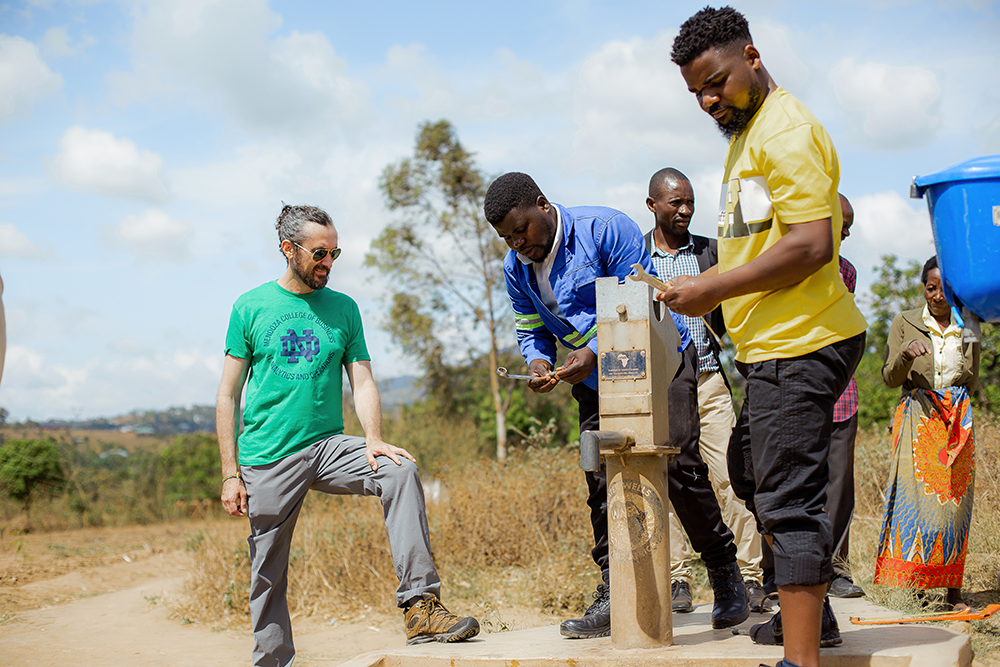
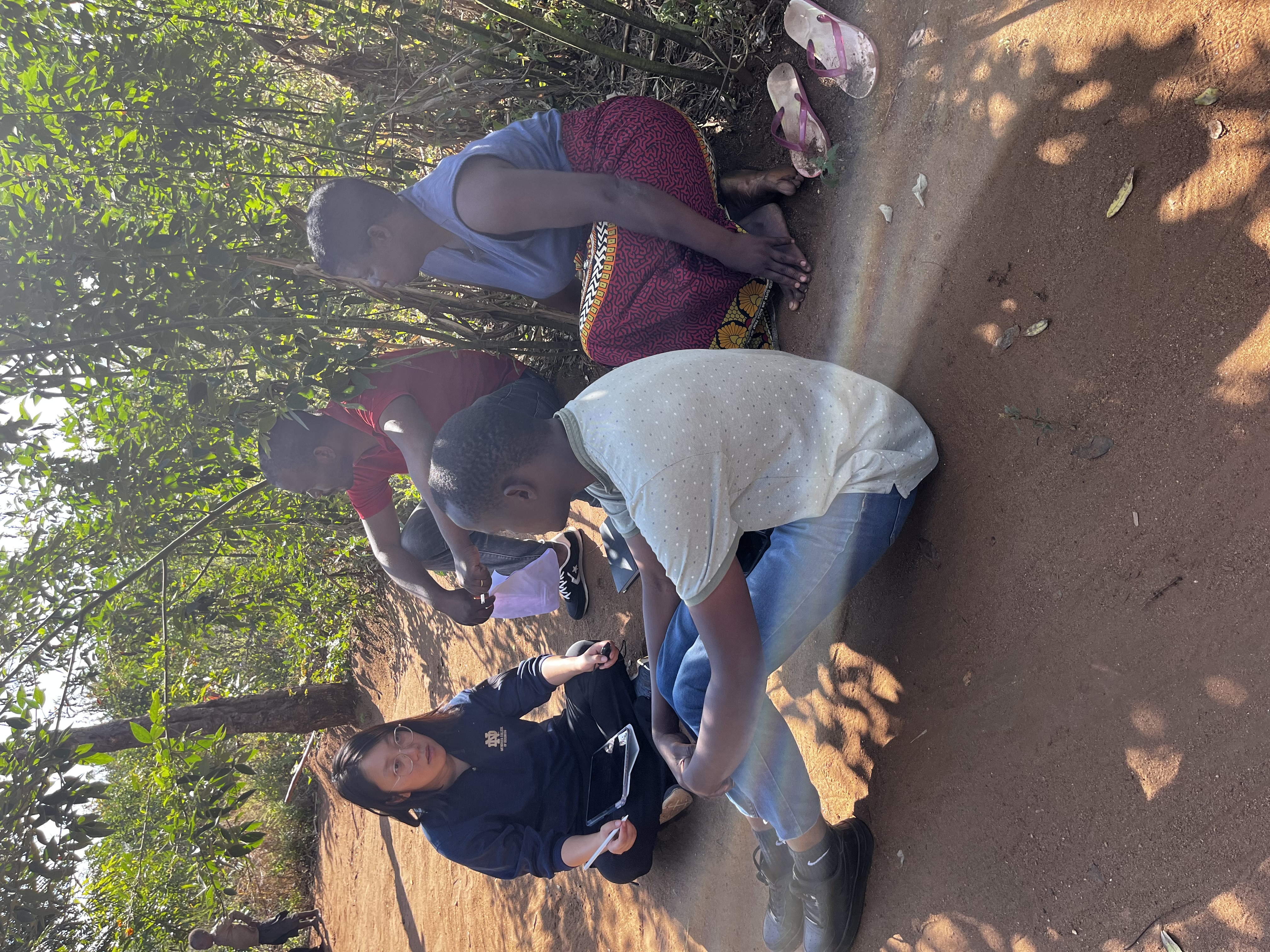 Its partnership with Notre Dame began six years earlier though, when Chencheng Zhai, assistant professor of ITAO, started working with Fisherman’s Rest to research access to clean drinking water under Pedraza-Martinez's supervision. Over the years, Zhai and Pedraza-Martinez have studied where to locate new water points in Malawi to improve access and equity, as well as how NGOs work with local communities to maintain and repair rural handpumps to ensure a reliable water supply. One of their research papers investigates the optimal location of new water projects. A second paper looks at the maintenance of existing water projects. A third paper examines the role of communities in keeping the water flowing. Besides scholarly publications, their research has been recognized with excellence awards at the Institute for Operations Research and the Management Sciences (INFORMS) and the Production and Operations Management Society (POMS).
Meanwhile, the student consultants can apply rigorous consulting in ways that are relevant to Fisherman’s Rest, strengthening operations to become a stronger organization to better serve its community.
The faculty’s scholarship takes a holistic approach to tackle this complex problem, one that directly addresses a crisis undermining health, education, gender equality and economic opportunity. By improving the accessibility and the reliability of rural water systems, their research makes a critical contribution to global development efforts.
“Growing up in rural Inner Mongolia, my first elementary school did not have running water, flushable toilets, or heating system,” Zhai recalled. “Collecting and purifying water was as essential to our daily classroom routine as our academic studies. In the winter, we dreaded being outside in the freezing cold. Families took turns donating coal each week to heat the stove. Throughout the day, we would boil the water to eliminate some of the bacteria.”
Zhai hopes her work means fewer children might have such experiences.
“I’ve promised to make the world a better place through my studies.”