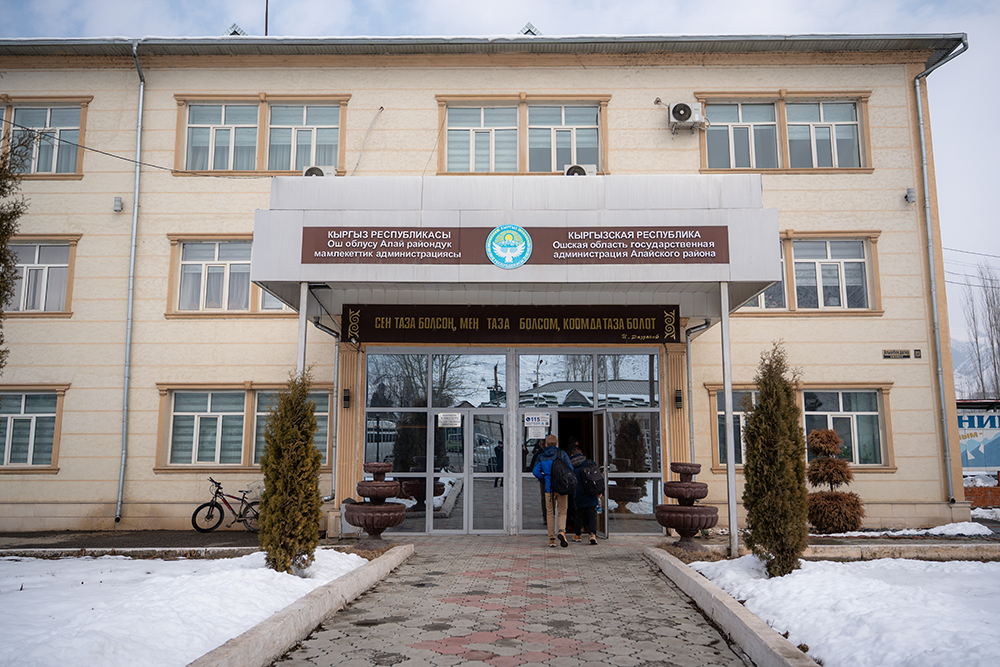
In Bishkek, the capital of the Central Asian republic of Kyrgyzstan, visitors can stroll along wide boulevards on broad sidewalks, maybe on their way to visit one of the city’s many stylish coffee houses. Travelers journey over smooth highways through the Tian Shan mountain range, taking in not only gorgeous scenery, but also mines and dams that power the country’s national electrical grid.
It’s hard to imagine that a century ago, many Kyrgyz lived as they had for generations, a nomadic life shifting seasonally with their horses, herds and yurts. Life moved this way until the early part of the 20th century, when the USSR imposed a collective, planned economy on the Muslim horsemen and shepherds of the mountains and steppes.
“Dushanbe, the capital of Tajikistan, was literally a rural marketplace in 1922 when the Soviets took control and turned it into the national capital,” said Justin Jones (MBA ‘16), an alumnus of the Meyer Business on the Frontlines program who has advised student teams in Tajikistan and Kyrgyzstan for the past four years. “The Soviet Union built all this infrastructure. They brought a lot of development.”
Business on the Frontlines’ mission, since its 2008 founding at the Mendoza College of Business at the University of Notre Dame, has been to explore business solutions for problems such as poverty and exclusion by partnering with community organizations serving the regions affected by such issues. Doing this work in Central Asia represented a departure from most Frontlines projects.
Addressing a “Soviet Hangover”
Soon after Ken Meyer (BS ‘66) endowed the Frontlines program in 2021, the team reexamined its future strategy, goals and aspirations.
“We analyzed where people are most affected by issues like economic exclusion, violence and climate change,” said Kelly Rubey (MBA ‘16), teaching professor and Frontlines alumna and instructor. “From that, a clear opportunity emerged in the Central Asian region.”
The Soviet infrastructure belies much of the countries’ challenges. Rural poverty rates are as high as 80% and unemployment is rampant. The region’s complex geopolitical reality – landlocked, bordering risky neighbors, a post-Soviet dependence on Russia and China – and its rich, preserved culture offered a fascinating opportunity for social impact and business problem-solving projects.
The Notre Dame network proved crucial in answering the next question: Which Central Asian organization would make the best partner?
Michael Kocher (JD ‘85) happens to be the president of the Aga Khan Foundation. AKF and its sister agencies in the Aga Khan Development Network (AKDN) were founded nearly 60 years ago by His Late Highness the Aga Khan IV, leader of the Shia Ismaili Muslims. AKDN channels $1 billion a year into development projects in some of the poorest and most remote regions of Asia and Africa.
“We reached out, and Michael connected us to Accelerate Prosperity, which is part of the Aga Khan Development Network,” remembered Rubey.”
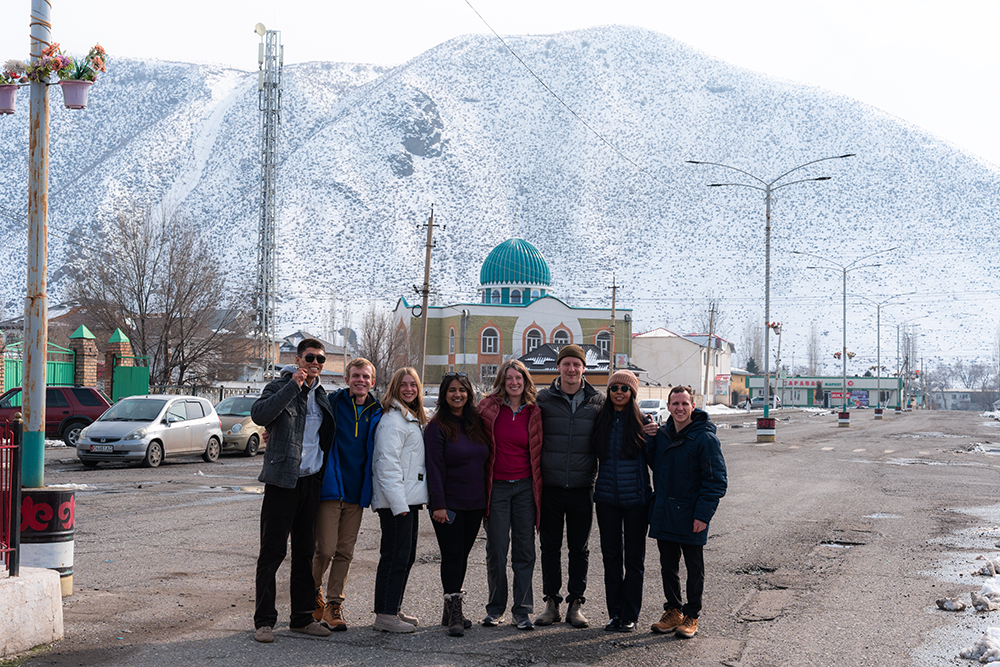
Imran Shams is Accelerate Prosperity’s executive director, overseeing the global work that also includes Afghanistan, Pakistan and, perhaps soon, Uzbekistan, Syria and Kazakhstan. “Our main objective is to promote entrepreneurship and address the lack of jobs, particularly for young people, by helping them create and join sustainable businesses,” he said.
The now four-year partnership between Accelerate Prosperity and Notre Dame's Business on the Frontlines, where Notre Dame MBA and other graduate students spend a semester co-creating economic development solutions with partner organizations, has played a small role in the big vision of AP: to help build the entrepreneurial infrastructure that decades of Soviet rule repressed.
“A Kyrgyz entrepreneur we met called it the ‘Soviet hangover,’" said Ian McKay (JD ‘23), who has been both a Frontlines student and alumni advisor in Kyrgyzstan. “He meant that people didn't really know what entrepreneurship was. They were used to being provided for by the state or working at a factory. Then they had to figure out how to generate income and create their own opportunities.”
More than three decades after independence, structural challenges persist.
Is impact investment the future of business and capitalism?
Jones sees immense opportunity, though. “It's a region that has been between geopolitical powers for a long time, and they are coming into their own,” he said. “Accelerate Prosperity is really interestingly positioned.”
“They are facilitating that change where entrepreneurs learn, grow and go from a small business that you're running to feed your family to hiring employees and buying an office or other real estate.”,” he added.
According to Shams, AP’s investments fall in the bracket of $10,000 to $500,000, a range considered a “missing middle” of financial services for the unbanked businesses in these countries, particularly startups. He said research from Notre Dame students directly shaped one of AP’s most successful initiatives — large-scale passive solar greenhouses during the first engagement in 2022 in Tajikistan.
“Before the students’ research, the target region had a lot of small, grant-based greenhouses that weren’t sustainable. Their work showed that large-scale greenhouses could actually be viable businesses,” he said. “Now, these greenhouses not only improve food security in regions like Gorno-Badakhshan Autonomous Oblast, but also create surplus income for families who can reinvest in education and better living conditions. Larger greenhouses benefit more households and offer a sustainable, scalable solution to food insecurity.”
Subsequent teams working in Kyrgyzstan with AP focused on strengthening the tech ecosystem, exploring possibilities for green construction operations, and on fintech approaches that would expand financial inclusion. Each project is built on the idea that when an organization invests by first considering social and environmental outcomes, it’s good for all.
McKay remembers meeting millennial and Gen Z entrepreneurs, those who, unlike their parents, grew up after the era of Soviet rule, during his project in 2023.
“They view the world differently than their parents and their grandparents' generations. They look for opportunities abroad and then want to bring back ideas to Kyrgyzstan,” he said. “It's great seeing organizations like Accelerate Prosperity come along and facilitate a whole network and help accelerate change at the grassroots level and connect people who might not necessarily be connected.”
The 2025 project, for which he was an advisor, undertook researching and co-creating solutions to small business owners’ access and usage of quality financing. The team spoke to coffee shop operators in the capital, families who own lodges in mid-sized towns and women entrepreneurs from Alai Mountain villages.
“The women probably would never have interacted if Accelerate Prosperity hadn't first been there to teach them the skills and connect them to different opportunities to learn and grow,” said McKay.
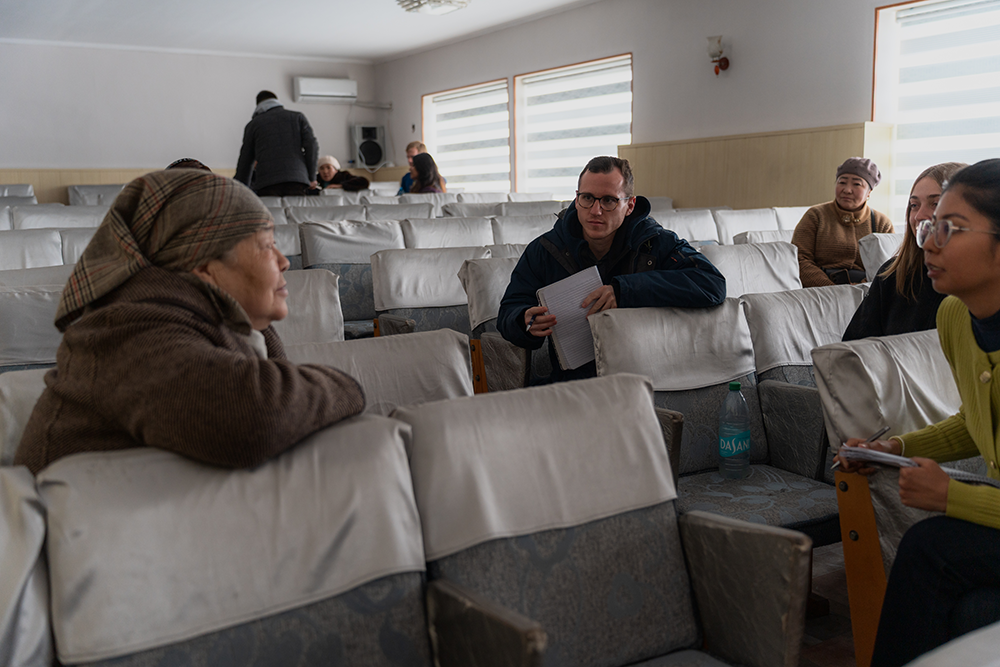 Holly Fulbright (MBA/JD ’26), a student on the 2025 team, was surprised by the sophisticated innovation and tech they found in Kyrgyzstan, perhaps helped by the infrastructure in place that many emerging economies lack.
“We considered things at a higher, more abstract level. Instead of solving a concrete problem, we were given a broad idea and told to run wild. This was both liberating and paralyzing.
“Kyrgyzstan was also complex because our solution had to accommodate a vast rural/urban divide,” she said. “The financial inclusion solutions we thought worked in cities might not have worked in rural areas.”
Fulbright’s team’s project illustrated a key Frontlines foundation: solutions must be built from the ground up and adapted to fit community needs.
A foundation of faith
In the Eastern Hemisphere, AKDN is a widely recognized, important player, not only among the Ismaili branch of Shia Islam. AKDN is non-denominational and works with everyone, wherever it is present, employing and benefiting people of all faiths and backgrounds. Ismailis themselves embrace difference as a strength and advance pluralism, inviting believers to engage with others regardless of their beliefs. Among many other activities, AKDN runs multiple universities in Central and South Asia and Africa focused on education and job creation. Their influence, relationships and mission align with Notre Dame’s.
"Faith guides their work, which is so similar to us at Notre Dame. And their work is inclusive of all religions despite being guided by the Muslim faith, much like ours," said Rubey.
“I spend a lot of time thinking about how my faith impacts my work,” said Jones. “I have found many of the people we work with [at AP] mirror a similar approach, where it's deeply rooted and at the core of why they're doing what they're doing,”
He remembers conversations with AP partners who left higher paying corporate jobs to try to make people's lives better. One Tajik man told him, “I'm trying to find a way to help them, not to make money.”
“He was making money, but that was the order for him.”
Nomadic roots and future growth
It feels like a new era is coming for Central Asia and AP. With recent major investment from the UK and Switzerland and planning underway to expand investment activity in Central Asia, it’s an exciting time for the communities AP serves. Although there isn’t a project planned for Frontlines students in 2026, the connection continues.
"I believe that Notre Dame students are kind of pioneers in exploring, and that really helps, because we are a very meaningful player in the market and ecosystem of tech startups and entrepreneurship support," said Jyldyz Isabekova, country director for Accelerate Prosperity in Kyrgyzstan.
Economists say that sustaining economic growth in the region requires reforms that foster a dynamic and innovative private sector, entrepreneurship and technology adoption. In Kyrgyzstan specifically, the challenge is amplified by limited government support. Unlike neighbors where governments invest billions in startup ecosystems, Kyrgyzstan's initiatives come from the bottom up — exactly where organizations like AP operate.
“A boom is happening and lifting us up from our nomad roots,” said Azim Abdrakhmanov, a young AP entrepreneur who has launched a series of startups.
“I'm convinced that the Kyrgyz people have a bright future,” said Fulbright. “Countless people made me feel like I belonged through sing-alongs, thoughtful conversations, shared meals and parting gifts. The Kyrgyz people have an uncanny ability to welcome and overcome barriers to connection.”