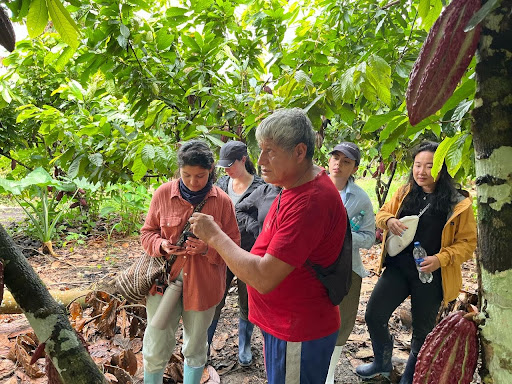
Madre de Dios, Peru is an Amazonian region of extraordinary biodiversity facing pressure from deforestation, illegal gold mining and climate change. In response to these challenges, the Cooperativa Agraria de Servicios Múltiples Sur Oriente (COOPSSUR) was founded in 2018 with the support of Cáritas Madre de Dios, an organization dedicated to the poorest and most vulnerable populations, to provide smallholder farmers with a sustainable, market-driven alternative through organic and conventional cacao and copoazú production. COOPSSUR’s growth represents an important cultural and economic shift toward environmental stewardship and rural development in a historically extractive landscape.
A team of students and advisors from the Regenerating Ecologies and Economies for Livelihoods (REEL) course collaborated with Cáritas Madre de Dios on the first part of a multi-year partnership. Our project aimed to assess how COOPSSUR’s internal organizational structures influence member motivation, cohesion, and engagement, and to identify strategies to strengthen governance, transparency and operational resilience as the cooperative grows.
The research employed a qualitative ethnographic approach, incorporating five focus group discussions and nine key informant interviews with cooperative members across five agricultural zones. These were complemented by 21 member surveys and seven interviews with COOPSSUR’s strategic partners. We conducted a benchmarking analysis of successful cooperative models in Peru, Honduras and Ethiopia to inform practical recommendations.
The analysis revealed that while localized community ties within COOPSSUR remain strong, cooperative-wide communication is fragmented and member engagement with leadership is limited. Members expressed concerns about unequal access to resources, lack of transparency in decision-making and unclear governance structures. Nevertheless, members recognized COOPSSUR’s vital role in securing market access, providing technical training and linking them to public funding opportunities. Strategic partners view COOPSSUR as a promising but capacity-constrained organization in need of stronger internal management and cohesion to fully realize its potential.
Our key recommendations include (1) Defining clear engagement expectations and transparent benefit distribution criteria to strengthen fairness and accountability, (2) Improving internal communication through the launch of a monthly bulletin and consistent quarterly general assemblies paired with technical workshops, (3) Investing in technical support, post-harvest infrastructure and management capacity to improve product quality and organizational resilience, (4) Expanding access to financial tools and working capital to support production cycles and reduce liquidity challenges.
Future research and technical assistance should focus on evaluating COOPSSUR’s business model sustainability, refining pricing strategies for value-added products, modernizing quality control and disease management systems, and establishing robust internal monitoring and evaluation frameworks. Strengthening these areas will be critical to ensuring the cooperative’s long-term viability and scaling its impact across Madre de Dios.