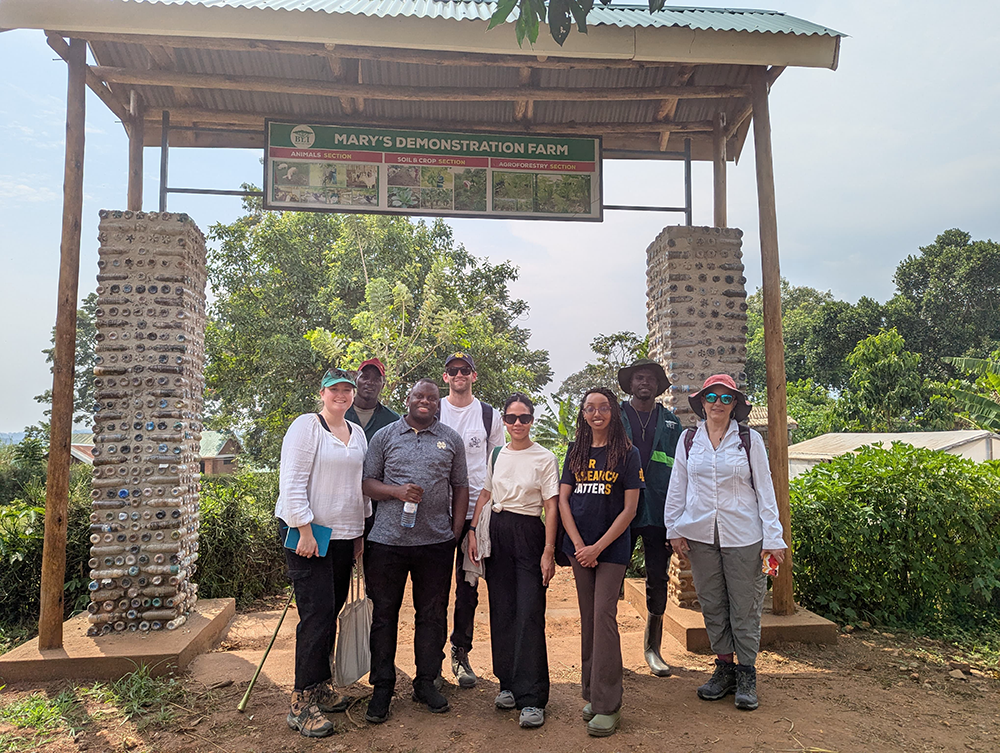
Bethany Land Institute (BLI) is an organization founded in 2012 as a response to the interconnected issues of poverty, food insecurity, environmental degradation and youth unemployment present in Uganda. Based in Luweero district, BLI answers the call set forth by the late Pope Francis’ groundbreaking 2015 encyclical Laudato Si,’ which emphasized the necessity to “care for our common home,” the Earth. Uganda’s rapid population growth and lack of ecological policies have led to extensive deforestation, worsening environmental and economic conditions. Many rural youth face unemployment, leading them to unsustainable livelihoods like charcoal burning, further exacerbating ecological damage. Through the educational program provided by BLI, Ugandan youth are trained as caretakers in the practices, lifestyle and spirituality of sustainable land care, food production and economic expertise in rural Africa. By integrating environmental restoration with economic development, BLI seeks to distinguish itself as a leader of sustainability and integral ecology in rural Africa.
Our team partnered with BLI – a continuation of the relationship established the prior year – to design the framework for establishing BLI as a research hub, and create and pilot a baseline survey to determine the impact of integral ecology practices on the villages within Nandere Parish. We split into two sub-teams to accomplish each respective goal: Team Hub and Team Survey.
Team Hub conducted a total of 14 key informant interviews, three focus group discussions, a vision activity, observation, informal discussions and follow-up interviews. Team Survey administered 35 surveys across three villages in Nandere Parish and one focus group discussion. Strengths identified include the awareness and commitment by BLI staff towards the transition into establishing itself as a research hub, the progress towards BLI accrediting its Integral Ecology curriculum for caretakers, and opportunity for community engagement whereby community members have expressed strong interest in training and workshops in their villages to improve agroforestry practices. Areas for growth include lack of staff awareness in data management and siloed decision-making hindering organizational cohesion, project implementation issues due to lack of intentional planning and innovation promotion, infrastructure and resource constraints related to community members’ access to water, sustainable farming inputs and unpredictable seasonal changes, as well as absence of formal community communication structures that prevent efficient data collection activities and feedback loops.
Based on the findings from the field and the strategic plan, we developed a series of four recommendations. The recommendations cover the areas of (1) data management infrastructure, (2) increasing community engagement, (3) developing a strong marketing strategy and experience for visiting researchers and partnerships, and (4) growing partnerships and monetizing intellectual property.